
How Do Drainage Solutions Improve Water Efficiency in Dallas Commercial Landscaping?
Proper drainage solutions improve water efficiency in Dallas commercial landscaping by directing stormwater where it can be absorbed, stored, reused, or safely discharged instead of allowing it to pool or run off uncontrollably. Effective drainage also protects soil and plant roots, reduces erosion, and helps irrigation systems deliver water more efficiently across the landscape.
At Metro Lawn Care, we understand that water-efficient commercial landscaping involves more than simply reducing irrigation. It requires managing water from the moment it reaches the property. For Dallas businesses, office campuses, retail centers, multifamily communities, and other commercial properties, drainage is an important part of that strategy. Our team takes a property-wide approach, considering grading, turf and planting areas, irrigation, and hardscapes together. The result is a landscape designed to handle North Texas weather while supporting attractive, healthy grounds and responsible water use.
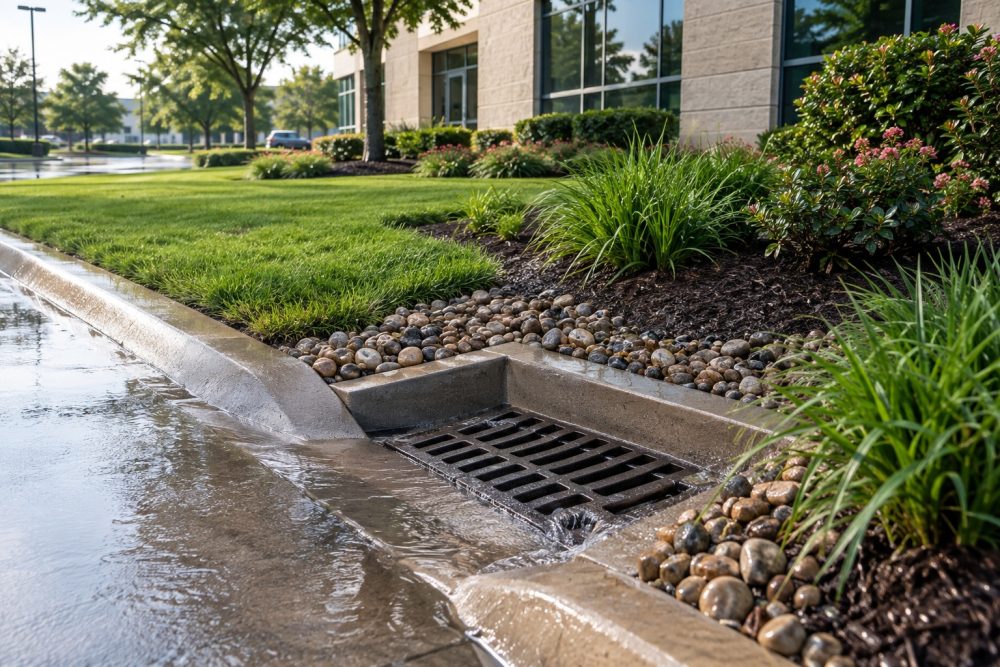
Commercial Landscape Drainage Helps Dallas Properties Manage Water More Efficiently
Dallas properties need to be prepared for both periods of limited rainfall and significant rain events. National Weather Service climate normals show that Dallas/Fort Worth receives about 37 inches of precipitation annually, with May averaging 4.78 inches and October averaging 4.37 inches. The same records show that DFW normally experiences nearly 11 days each year with at least one inch of precipitation.
That variability makes drainage and water management closely connected. A well-designed system helps move excess water away from vulnerable areas while, where appropriate, slowing, filtering, infiltrating, or capturing runoff for more efficient site-wide water management.
Why Is Proper Drainage Important for Water-Efficient Landscaping?
Drainage helps make sure water goes where the landscape can use or safely manage it. Without effective drainage, rain or irrigation water may collect in low spots, flow across pavement, erode soil, or leave some planting areas saturated while others remain dry.
The U.S. Environmental Protection Agency explains that developed properties generate more runoff because buildings, parking lots, roads, and other hard surfaces prevent precipitation from soaking naturally into the ground. This is especially relevant to commercial properties, where large roofs, parking areas, sidewalks, and drive lanes can concentrate significant volumes of stormwater.
An effective commercial drainage plan can help:
- Reduce standing water in turf and landscape beds
- Limit soil erosion and mulch washout
- Protect plant roots from prolonged saturation
- Direct runoff away from buildings and high-traffic areas
- Improve the effectiveness of irrigation
- Encourage infiltration where soil and site conditions permit
- Reduce unnecessary water loss from uncontrolled runoff
The goal is not simply to remove water as quickly as possible. It is to manage water according to the needs and limitations of the property.
What Drainage Solutions Work for Dallas Commercial Properties?
The right drainage solution depends on the property’s grading, soil, hardscape, runoff patterns, and existing infrastructure. There is no single drainage system that works for every commercial landscape.
Depending on site conditions, drainage strategies may include surface grading, catch basins, channel drains, underground drainage, swales, French-style drains, or combinations of multiple systems. Properties may also benefit from green infrastructure that manages water closer to where it falls.
For example, the EPA identifies bioswales and grassed swales as vegetated channels that slow, filter, and treat stormwater. Bioretention areas can temporarily collect runoff and then allow it to infiltrate or pass through an underdrain. Permeable pavement can similarly store water beneath the surface before infiltration or drainage occurs.
Not every property should rely heavily on infiltration. The EPA notes that sites with clay or compacted soils and low infiltration rates may require underdrains or systems designed to move water away rather than depending solely on absorption.
That is why evaluating actual site conditions should come before choosing a drainage solution.
Can Better Drainage Reduce Irrigation Waste?
Yes, better drainage can support more efficient irrigation by maintaining healthier soil moisture conditions and preventing water from collecting or escaping in the wrong areas. Drainage and irrigation should therefore be considered parts of the same overall water-management strategy.
For example, an area that stays saturated because of poor drainage may not need additional irrigation, even when another part of the property does. Simply adjusting irrigation schedules without addressing the drainage problem can waste water and contribute to unhealthy growing conditions.
Property managers should watch for warning signs such as:
- Puddles that remain long after irrigation or rainfall
- Water flowing across sidewalks or parking areas
- Eroded soil around beds and slopes
- Turf that remains unusually wet
- Bare or thinning areas along runoff paths
- Mulch repeatedly washing out of beds
- Areas that require significantly different irrigation than surrounding landscaping
These symptoms can indicate that the property’s water-management system needs to be evaluated as a whole.
How Can Drainage Protect Landscaping During Heavy Dallas Rain?
Effective drainage reduces the amount of uncontrolled water moving across a commercial property during storms. This can help protect turf, planting beds, hardscapes, and other landscape features from erosion, pooling, and saturation.
The need becomes clear when looking at North Texas rainfall extremes. Although DFW’s annual normal precipitation is 37.01 inches, National Weather Service records show substantial variation from year to year and between months. The area’s historical 24-hour precipitation extremes demonstrate that several inches of rain can fall within a single day.
The EPA reports that green infrastructure can reduce localized flooding by absorbing rainfall, slowing runoff, and temporarily storing stormwater. Vegetated swales, for example, can slow runoff while encouraging infiltration and filtering pollutants.
For commercial properties, combining appropriately designed drainage infrastructure with healthy landscaped areas can create a more resilient system than relying on either component alone.
What Should Property Managers Consider Before Improving Drainage?
Start with a site assessment rather than choosing a drain based only on where water is visible. The location of standing water may be the symptom, while the actual problem begins elsewhere on the property.
A professional assessment should consider grading and slopes, soil conditions, roof and downspout discharge, irrigation patterns, existing drains, parking-lot runoff, landscape beds, and where water ultimately leaves the property.
EPA guidance similarly recommends evaluating soil and subsurface conditions, infiltration rates, groundwater conditions, potential pollutants, and previous site uses when designing infiltration-based stormwater features.
Property managers should also plan for maintenance. Catch basins can collect debris, drainage lines can become obstructed, and swales or landscaped drainage features may lose effectiveness if vegetation, sediment, or grading changes over time. Routine landscape inspections provide an opportunity to spot these issues before the next major storm.
Frequently Asked Questions About Commercial Drainage in Dallas
What is the best drainage solution for a commercial landscape?
There is no universal best option. The appropriate solution depends on the property’s elevation, soil, runoff volume, impervious surfaces, existing infrastructure, and where water can safely be directed.
Can drainage make a commercial landscape more sustainable?
Yes. Well-designed drainage can reduce erosion, manage runoff, encourage appropriate infiltration, and support healthier soil and vegetation. EPA guidance describes green infrastructure as using soil, vegetation, permeable surfaces, and water reuse to store, infiltrate, or evapotranspirate stormwater.
How do I know if my Dallas property has a drainage problem?
Persistent standing water, erosion, washed-out mulch, chronically wet turf, runoff across pavement, and water collecting near structures are common warning signs. A site assessment can identify where the water originates and which drainage improvements are appropriate.
Should drainage and irrigation be evaluated together?
Yes. Irrigation controls how water is applied, while drainage determines what happens when soil cannot immediately absorb that water. Evaluating both systems together can reveal opportunities to reduce waste and improve landscape health.
Build a More Water-Efficient Dallas Commercial Landscape
Effective water management requires the right balance between getting plants the water they need and safely managing excess water when it arrives. For Dallas commercial properties, thoughtful drainage solutions can protect landscape investments, improve irrigation efficiency, reduce erosion, and help grounds perform better through changing weather conditions.
Ready to improve drainage and water efficiency across your commercial property? Contact Metro Lawn Care to discuss a drainage solution designed around your Dallas landscape.