
How Do Shading Solutions Benefit Commercial Lawns in Dallas?
Shading solutions benefit Dallas commercial lawns by reducing heat exposure, cooling outdoor areas, protecting selected landscape features from intense sunlight, and making properties more comfortable for employees, tenants, customers, and visitors. Strategic shade from trees, structures, and landscape design can also reduce heat around pavement and buildings, helping commercial properties remain attractive and usable during hot North Texas weather.
Metro Lawn Care understands that maintaining a commercial landscape in Dallas requires more than keeping turf mowed and beds tidy. Heat, intense sunlight, irrigation demands, building shadows, parking lots, and heavy foot traffic all influence how a landscape performs. By looking at the entire property, Metro Lawn Care can help commercial property managers develop landscaping strategies that balance shade with the sunlight turf and plants need to thrive. The goal is a polished, functional landscape that supports curb appeal while addressing the realities of the Dallas climate. From office campuses and retail centers to industrial properties and multifamily communities, thoughtful landscape planning can help outdoor areas work harder for the businesses they serve.
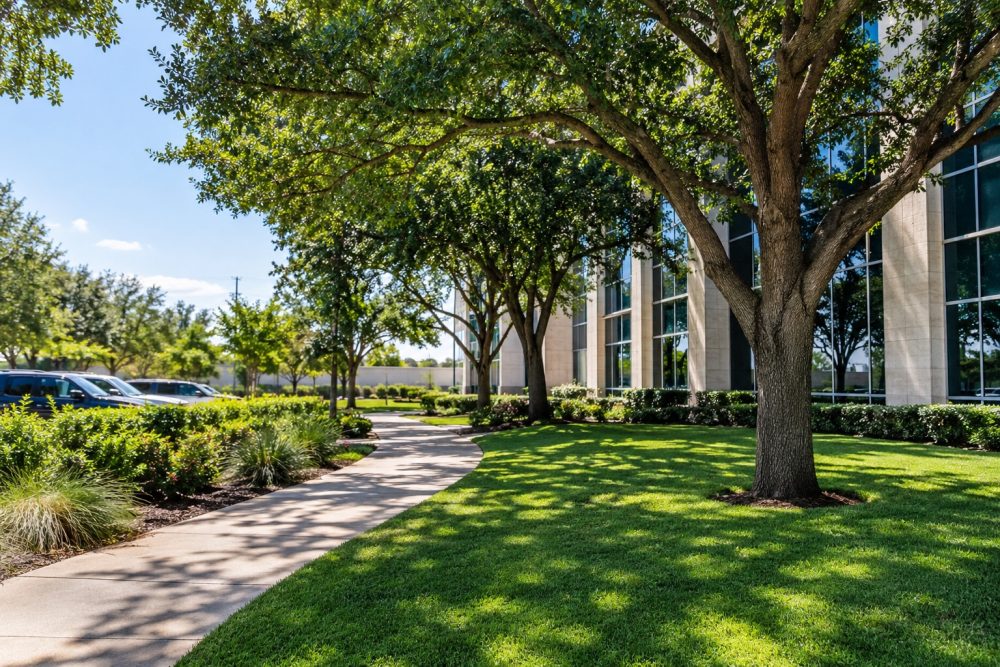
Commercial Landscape Shade Strategies for Dallas Properties
Effective commercial shading is about putting the right amount of shade in the right places, rather than simply covering as much lawn as possible. Trees, architectural shade structures, pergolas, covered seating areas, and carefully selected plants can all play a role.
The U.S. Environmental Protection Agency (EPA) reports that trees and vegetation lower surface and air temperatures through shade and evapotranspiration. A review of 308 studies cited by the EPA found urban forests were, on average, 3°F cooler than urban non-green areas.
For Dallas businesses surrounded by parking lots, sidewalks, roofs, and other heat-absorbing surfaces, that cooling effect makes shade an important component of landscape planning.
How Does Shade Help a Commercial Property Stay Cooler?
Strategically placed shade reduces the amount of solar energy absorbed by pavement, walls, outdoor amenities, and other surfaces. That can make landscaped areas and pedestrian spaces more comfortable during Dallas summers.
The EPA notes that shaded surfaces can be 20 to 45°F cooler at peak temperatures than comparable unshaded materials. Trees and vegetation also cool their surroundings through evapotranspiration.
This can be especially valuable around:
- Building entrances and walkways
- Employee break and seating areas
- Multifamily common spaces
- Retail pedestrian areas
- Parking lots and sidewalks
- Outdoor dining or gathering areas
Shade can therefore become part of the property’s overall experience, not simply a landscaping feature. A comfortable outdoor environment encourages people to use spaces that might otherwise sit empty during warmer parts of the year.
Can Shading Solutions Reduce Commercial Property Energy Needs?
Trees and vegetation positioned near buildings can help reduce cooling demands by lowering surrounding temperatures and shading building surfaces.
According to the EPA, trees and vegetative cover can lower ambient temperatures through shading and evapotranspiration, which can reduce the energy required for air conditioning during summer.
Placement matters. Trees should be selected and located according to their mature height and canopy spread, while accounting for buildings, utilities, visibility, irrigation, parking areas, and pedestrian circulation.
For property managers, that means a shade plan should be developed as part of the larger commercial landscape strategy rather than treated as an isolated improvement.
Is Too Much Shade Bad for Commercial Lawns?
Yes. While shade can benefit a commercial property, excessive shade can cause turf to thin or fail because grass still needs adequate light for healthy growth.
Texas A&M AgriLife Extension reports that even St. Augustinegrass, generally considered the most shade-tolerant warm-season turfgrass, typically requires at least four to six hours of light per day. In heavily shaded locations, Texas A&M recommends considering alternatives such as mulch or shade-tolerant perennial plantings.
The best solution depends on conditions at the individual Dallas property. In areas where turf consistently struggles, property managers might consider:
- Shade-tolerant turf varieties
- Groundcovers or perennial plantings
- Mulched landscape beds
- Tree canopy management
- Adjustments to irrigation and mowing practices
- Converting difficult turf areas into functional landscape features
Texas A&M’s Dallas turfgrass research program specifically evaluates cultivars for traits such as shade tolerance and water efficiency. Its research identifies several zoysiagrass varieties with shade tolerance, including Palisades, Zorro, Royal, and Diamond.
The takeaway is simple: commercial shade should be managed, not maximized.
What Types of Shading Solutions Work Best for Dallas Commercial Properties?
The best shading strategy usually combines living and structural solutions based on how people use the property and how much sunlight each landscape area receives.
Trees are an obvious option because they can provide shade while contributing to curb appeal and the overall landscape design. However, trees require appropriate species selection, sufficient root space, irrigation during establishment, pruning, and long-term canopy management.
Structural solutions can complement landscaping in locations where immediate or predictable shade is needed. Depending on the property, options may include pergolas, covered seating areas, shade canopies, and other architectural features.
A practical approach is to identify the property’s hottest and most heavily used areas first. Look at where employees walk at lunchtime, where residents gather, which sidewalks receive afternoon sun, and where turf repeatedly declines beneath existing tree canopies.
From there, shade can be incorporated strategically rather than uniformly.
How Can Property Managers Balance Shade, Water Use, and Curb Appeal?
Start by designing for site conditions rather than forcing the same turf and plant palette throughout the property.
Texas A&M AgriLife recommends considering factors such as sunlight, soil quality, traffic, irrigation, intended use, and maintenance requirements when selecting turfgrass for Texas landscapes. Those same principles are useful for commercial landscape planning.
Property managers can improve results by periodically evaluating:
- Sun exposure: Identify areas receiving full sun, partial shade, or heavy shade.
- Plant performance: Look for thinning turf, scorched plants, bare soil, or declining landscape beds.
- Irrigation coverage: Make sure watering schedules reflect differences between sunny and shaded areas.
- Tree canopy: Maintain trees for health, safety, appropriate clearance, and balanced growth.
- Property use: Prioritize shade where tenants, employees, customers, and visitors will actually benefit from it.
This site-specific approach is particularly important on Dallas commercial properties, where buildings and large paved areas can create dramatically different conditions within the same landscape.
Frequently Asked Questions About Commercial Lawn Shade
Does shade reduce the amount of water a commercial lawn needs?
Shade can reduce direct solar exposure and evaporation, but irrigation requirements depend on turf species, soil, tree-root competition, drainage, and the type and duration of shade. Irrigation should be adjusted according to actual site conditions rather than assuming every shaded area needs the same watering schedule.
What grass grows well in shade in Dallas?
St. Augustinegrass is generally the most shade-tolerant warm-season turfgrass, according to Texas A&M AgriLife, while several zoysiagrass cultivars also offer good or excellent shade tolerance. The best choice depends on traffic, irrigation, maintenance expectations, and the amount of available light.
Should I keep grass under large shade trees?
Only when the turf receives enough light to remain healthy. If grass repeatedly thins beneath a dense canopy, converting the area to mulch, groundcover, or shade-adapted plantings may provide a more attractive and sustainable commercial landscape.
Are shade trees good for commercial parking areas?
Yes, when properly selected and positioned. The EPA recommends strategically using trees and vegetation around parking lots, streets, and buildings to provide cooling and reduce heat-island effects.
Create a More Comfortable Dallas Commercial Landscape
A successful shading strategy can make a Dallas commercial property cooler, more inviting, and more functional while supporting an attractive overall landscape. The key is balancing shade with turf requirements, irrigation, tree health, traffic patterns, and long-term maintenance.
Ready to explore shading and landscaping solutions for your Dallas commercial property? Contact Metro Lawn Care to get started.